

Humans are mimetic creatures. The French thinker René Girard argued that we learn what to want by watching what other people want. We copy the career, the house, the body and the lifestyle of those around us, often without asking whether their priorities, values and history look anything like ours. We end up chasing someone else’s life and wondering why it does not fit.
So the more useful question is not “What do I want to have?” but “Who do I want to be?” Islam and Stoicism, separated by centuries and geography, give remarkably similar answers, and modern psychology supports much of what they say.
Identity comes before habit
Epictetus, the former slave who became one of Rome’s most respected teachers, put the order of things plainly:
“First say to yourself what you would be; and then do what you have to do.” (Epictetus, Discourses 3.23)
The underlying principle appears again and again in the research: we work hard to act in line with who we believe we are.
This is why “I want a body like that person’s” rarely lasts, while “I am the kind of person who moves every day” can. The first is a comparison. The second is an identity, and every workout becomes evidence for it.
The Prophet ﷺ taught the same patience with small, steady action. When he was asked which deeds Allah loves most, he said: “The most regular constant deeds even though they may be few” (Sahih al-Bukhari 6465). An identity is built in exactly this way, one consistent deed at a time. The Qur’an tells us where that change begins: “Allah will not change the condition of a people until they change what is in themselves” (Qur’an 13:11).
The danger of a single story
We all play many roles. We are sons and daughters, parents, spouses, siblings, friends, employees, neighbours and members of a community. Trouble starts when one role swallows all the others.
Think of the executive whose entire sense of self is tied to the company. When the company folds or the position is cut, the loss is not only financial. It feels as though the person has disappeared, because there is nothing else left to stand on.
Psychologist Patricia Linville called the alternative “self-complexity.” In a 1987 study, she found that people who saw themselves in terms of more distinct roles and traits were less prone to depression, perceived stress, physical symptoms and illness after a run of stressful events. Her explanation was simple: when one part of life takes a hit, the other parts stay intact and act as a buffer. Later reviews found the effect less consistent than her original results suggested, but the core idea has endured: do not put your entire self in one basket.
So when a job disappears, a person with a full life as a parent, friend, sibling or volunteer has somewhere to turn. They lean on their family and friends, and they are reminded that they are still someone.
Everything we hold is on loan
Both traditions go further than spreading the risk. They ask whether we ever owned these roles at all.
“Never say of anything, I have lost it; but, I have restored it. Has your child died? It is restored. Has your wife died? She is restored. Has your estate been taken away? That likewise is restored.” (Epictetus, Enchiridion 11)
While we have something, Epictetus says, we should “hold it as something not your own; as do travellers at an inn.” Status, wealth and titles belong to fate, not to our moral character, which the Stoics called prohairesis, our faculty of choice. Losing a role is like checking out of a hotel room you never owned.
For Muslims, this is not only a philosophy but a creed. Everything belongs to Allah, and we are trustees of whatever He places in our hands. When calamity strikes, we say:
إِنَّا لِلَّٰهِ وَإِنَّا إِلَيْهِ رَاجِعُونَ
Inna lillahi wa inna ilayhi raji’un. “Indeed we belong to Allah, and indeed to Him we will return.” (Qur’an 2:156)
These words come directly after Allah tells us that He will test us with fear, hunger and the loss of wealth, lives and fruits, and gives good news to those who are patient (Qur’an 2:155).
The Prophet ﷺ taught Umm Salamah to follow these words with a short prayer asking Allah to reward her in her affliction and replace what she lost with something better. She said it when her husband Abu Salamah died, wondering who could be better than him, and Allah gave her the Prophet ﷺ himself as a husband (Sahih Muslim 918).
Marcus Aurelius held the highest political office in the Western world, yet he refused to let “Emperor” become his whole identity. He warned himself: “Take care that thou art not made into a Caesar, that thou art not dyed with this dye” (Meditations 6.30). And he wrote: “My city and country, so far as I am Antoninus, is Rome, but so far as I am a man, it is the world” (Meditations 6.44). He was an emperor by assignment and a human being by nature.
Play the part you are given, and play it well
Epictetus compared human life to a play in which the playwright assigns the parts:
“Remember that you are an actor in a drama, of such a kind as the author pleases to make it. If short, of a short one; if long, of a long one. If it is his pleasure you should act a poor man, a cripple, a governor, or a private person, see that you act it naturally. For this is your business, to act well the character assigned you; to choose it is another’s.” (Epictetus, Enchiridion 17)
Because a role is an assignment rather than your essence, you can move from wealthy to poor, or from public official to private citizen, without believing your true self has been destroyed.
Epictetus also taught that each role carries its own duties. “Consider who you are,” he told his students: first a human being, then perhaps a son, a brother, a councillor, a father. “Each of these names, if it comes to be considered, always points out the proper duties” (Discourses 2.10).
The Prophet ﷺ said something very close: “All of you are shepherds and each of you is responsible for his flock” (Sahih al-Bukhari 893). The ruler, the head of a household, the wife caring for her home and the worker entrusted with property each have a flock. The question is never only “Who am I?” but also “What does this role ask of me today?”
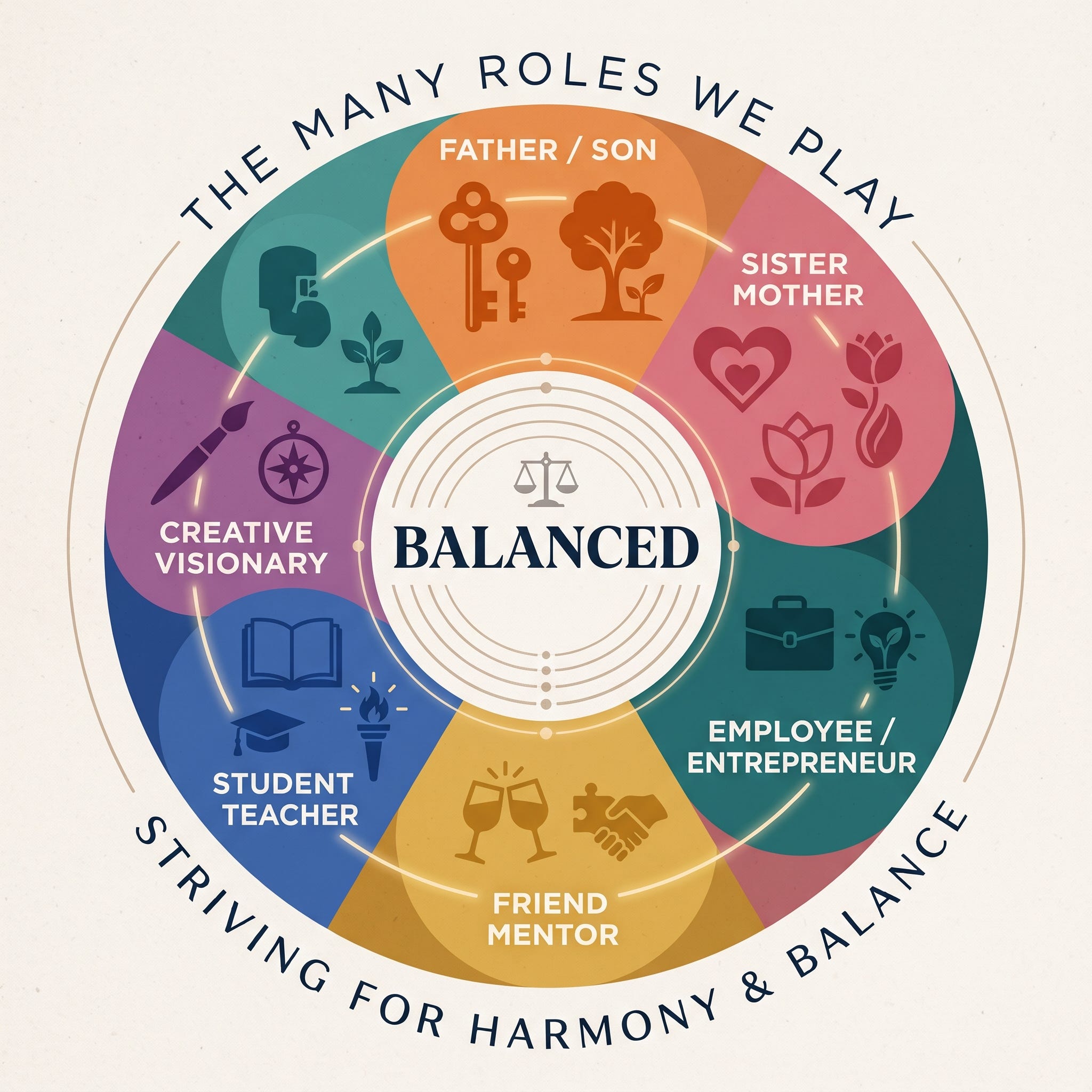
Giving every right its due: the Prophetic model
The Seerah of the Prophet Muhammad ﷺ shows one man carrying many roles at once. He was the Messenger of Allah receiving revelation, and he was also a devoted father, an affectionate husband, a loyal friend, a statesman and a courageous leader in battle. Rather than letting these roles compete, he gave each of them its rightful due (haqq). Three principles stand out.
Give every right its due. The Companion Abu al-Darda once devoted himself so completely to fasting and night prayer that his wife was left neglected. His brother in faith, Salman al-Farsi, stayed with him, persuaded him to eat and to sleep, and then woke him for prayer in the last part of the night. Salman told him: “Your Lord has a right on you, your own self has a right on you, and your family has a right on you, so give everyone their due rights.” When Abu al-Darda reported this to the Prophet ﷺ, he said: “Salman has spoken the truth” (Sahih al-Bukhari 1968). The Arabic phrase, fa aʿṭi kulla dhī ḥaqqin ḥaqqah, is one of the most complete statements of balance in the Sunnah.
Be fully present, then move on. When Aisha was asked what the Prophet ﷺ did at home, she replied: “He used to keep himself busy serving his family and when it was the time for prayer he would go for it” (Sahih al-Bukhari 676). Home was not an afterthought to his mission, and his mission did not vanish when he was at home. Each role had its time, and he gave it his full attention.
Lead by example, not privilege. Aisha also described him at home: “He mended sandals and patched garments and sewed” (Al-Adab al-Mufrad 540, graded sahih by al-Albani). At the Battle of the Trench, the Companion al-Bara saw him carrying earth out of the trench until dust covered his abdomen (Sahih al-Bukhari 4106). The highest spiritual authority of his community did not consider any honest role beneath him. He summed up where real excellence lies: “The best of you are the best to their families, and I am the best to my family” (Jami’ al-Tirmidhi 3895, graded hasan sahih).
Balance changes with the seasons of life
Balance does not mean giving every role equal time. It means giving each role the weight that matches your values and priorities. One person treasures family time so much that they choose a lower-paying job with predictable hours. Another is building something and gladly works late for a few years. Neither is wrong if the choice is honest and aligned with what they value.
The right balance also depends on your season of life. When you are young, it can make sense to work long hours to earn a promotion. Towards the end of a career, it is perfectly reasonable to turn that promotion down and focus on your health, your family and your worship.
Stanford psychologist Laura Carstensen’s socioemotional selectivity theory describes this shift. As people sense that their time horizon is shrinking, as it usually does with age, they invest more in emotionally meaningful goals and relationships and less in exploration and expansion. This is not decline. It is a sensible reordering of priorities.
The Sunnah contains a moving example. After the Prophet ﷺ advised Abdullah ibn Amr to moderate his fasting, Abdullah insisted on taking on more. Years later, in old age, he would say that it would have been better for him to accept the Prophet’s concession (Sahih al-Bukhari 1975). What suits one season of life can become a burden in another.
Anchor your identity in values, not outcomes
When we define who we are, the safest foundation is not possessions or titles but values and effort, because those stay within our control.
The Stoics practised what is often called the reserve clause. Seneca recommended adding a quiet condition to every plan: “I shall sail unless something happens,” or “My business will be successful unless something interferes” (On Tranquillity of Mind 13). A Stoic merchant would not say “I am a successful merchant.” He would say “I will run this business well, unless illness, war or a market collapse redirects me.” His identity stays tied to his effort and character, which he controls, rather than to his title or results, which he does not. When plans fail, the pivot is far less painful.
Muslims have an even older habit with a deeper root. Allah instructs: “And never say of anything, ‘Indeed, I will do that tomorrow,’ except [when adding], ‘If Allah wills’” (Qur’an 18:23-24). Saying insha’Allah is not a verbal tic. It is a daily reminder that we own the effort and Allah owns the outcome.
Here is what that shift can look like in practice:
Instead of saying → Try saying
I am a Senior Director → I work on meaningful projects with smart and kind people
I own a large home like everyone else → I am building a home filled with joy and love wherever I live
I want to be better than that person → I want to be better than I was last year
I am a Muslim who fulfils my duties → I am a Muslim who is always striving to strengthen my iman
I am a successful merchant → I will run this business with honesty and excellence, if Allah wills.
This kind of identity frees us from the grip of comparison. The Prophet ﷺ said: “Riches does not mean having a great amount of property, but riches is self-contentment” (Sahih al-Bukhari 6446).
He also gave a simple remedy for the mimetic trap we started with: “Look at those who stand at a lower level than you but don’t look at those who stand at a higher level than you, for that is better suited that you do not disparage Allah’s favors” (Sahih Muslim 2963).
Most importantly, it prepares us for the one transition no one escapes. The Prophet ﷺ said that a dead person is followed to the grave by three things: family, wealth and deeds. Two of them return, and only one stays: “relatives and his property go back while his deeds remain with him” (Sahih al-Bukhari 6514). Every title and possession will be handed back one day. What we become through our choices is what we take with us.
So, who are you?
Start by asking the question, not in one narrow way, but across every area of life that matters to you. Here is a simple exercise to try this week:
List the roles that matter most to you right now, for example servant of Allah, spouse, parent, child, friend, professional, neighbor and caretaker of your own body.
For each role, write one identity statement that is anchored in values and effort rather than titles or possessions.
Ask Salman’s question: which of these has a right over me that I am not currently giving?
Name your season of life. Which roles deserve more weight now, and which can wait?
Come back to your answers once a year, or whenever life changes direction.
Your identity is not fixed. It will keep evolving as you move through the seasons of life, and that is how it should be. Play each part you are given as well as you can, hold every title as something borrowed, and keep your heart attached to the One to whom everything returns.