

We live in a world where so many of us have left the place of our birth to make a life in a foreign land. So what is our identity now? Where do we actually belong? Too many of us answer that question by living as renters: strangers in a borrowed country, holding our breath, waiting to go somewhere that no longer exists.
This is the great migration of our time. Muslims are moving across borders in enormous numbers, pushed by war, oppression, and poverty, or pulled by opportunity and the pursuit of knowledge. Leaving your birthplace is one of the hardest decisions a person can make. We tell ourselves it is temporary. Then the years pass, the children come, and the temporary quietly becomes permanent.
And still, many of us live like guests who never unpack. We retreat into small enclaves of people who look like us, eat like us, and pray like us. We take what the country offers and give little back. It is all extraction and no contribution.
That instinct is understandable. But it is not the way of our Prophet, and it is not the way of the wise.
The renter and the builder
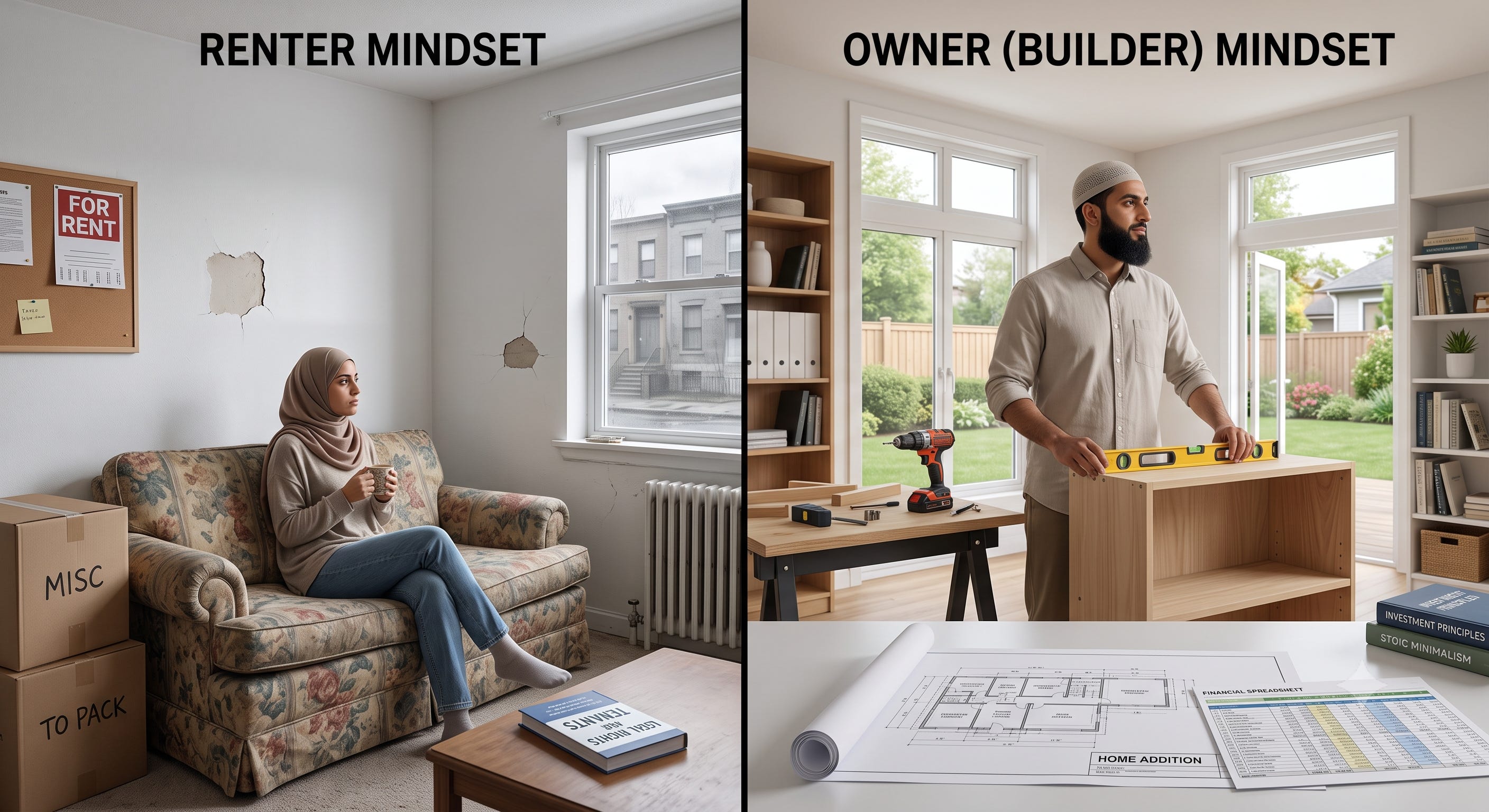
There are two ways to live in a land: as a renter, or as a builder.
The renter calculates. He thinks short term, keeps his head down, and treats every kindness from the wider society as a transaction. He uses a place without improving it, and when things get messy he moves on or waits for someone else to clean it up. He has no skin in the game.
The builder asks a different question: how do I leave this place better than I found it? He thinks long term and holds himself accountable. He fixes problems instead of cataloguing them, because he is invested in the outcome, financially, emotionally, and in his own good name. He acts like an owner, because he is one.
For a Muslim, this is not optional. Whether we are passing through or here to stay, our duty is to integrate and to benefit the people around us. The land does not improve on its own. Someone has to build.
The Prophetic blueprint
When the Prophet Muhammad ﷺ emigrated from Makkah to Yathrib, the city we now call Madinah, he did not arrive as a refugee waiting to be told what to do. He arrived as a builder.
The very first thing he did was establish a place of worship. At Quba, on the edge of the city, he founded a mosque that the Qur’an itself honors as the one “founded on piety from the first day” (Qur’an 9:108). He planted roots before he did anything else.
What he did next matters just as much. He did not wall himself off. Madinah was a diverse city of Muslims, Jews, and various tribes, and the Prophet ﷺ engaged with all of them. He helped improve the life of the city, drew up a covenant that bound its communities together, and made his presence felt as a benefit to everyone, not just to his own.
He also showed us how to be a guest. Before his own home was built, the Prophet ﷺ stayed for about seven months in the house of Abu Ayyub al-Ansari. Abu Ayyub cleared out his upper floor so the Prophet could have it, but the Prophet ﷺ insisted on staying on the ground floor, telling his host it would be easier on the household given how many visitors came to see him. This is the manner of a guest who thinks constantly about the comfort of his hosts. It is the opposite of the renter who thinks only of himself.
The lesson is hard to miss. Build, integrate, contribute, and be gracious. That is the blueprint.
The wisdom of the exiles
This truth is not ours alone. Long before any of us boarded a plane to a new country, philosophers outside our tradition were wrestling with the same ache of displacement, and they arrived at the very same place. They refused to be diminished by it.
Musonius Rufus, a Roman Stoic, was banished more than once, including to a barren island in the Aegean. He did not sulk and he did not shrink. Instead he reasoned that exile takes almost nothing from a person who understands what truly matters. He asked the question that dismantles the whole idea of homesickness:
“Is not the universe the common fatherland of all men?” (Lectures, IX). If the whole world is your homeland, you cannot be exiled from it.
Seneca the Younger spent roughly eight years exiled on the rugged island of Corsica. From there he wrote a letter meant to comfort his grieving mother. His argument is that the things which make a life worth living cannot be confiscated by a change of address:
“All that is best for a man lies beyond the power of other men, who can neither give it nor take it away.” Wherever a wise person stands, he carries his character and his usefulness with him, and so he is never truly homeless.
These men found home not in a patch of soil but in how they lived. A pagan philosopher on a rocky island and a believer following the Sunnah end up holding the same truth: home is something you carry and something you build, never something you simply wait to return to. And once you accept that, the question stops being whether this new land is really yours. It becomes what you owe it.
Citizenship is a covenant
Some of us go further and become citizens. To do so we swear an oath to honor a country and uphold its laws. As long as those laws do not force us to violate our beliefs, there is nothing wrong in this. A country like the United States, for instance, protects freedom of speech and freedom of religion, the very things that allow us to practice our faith openly.
But an oath is not a one-way ticket to benefits. When we take it, we take on responsibilities too. We cannot expect to enjoy a country’s opportunities while contributing nothing to its wellbeing. A Muslim keeps his promises and honors his oaths. That is not a slogan. It is a defining feature of our character.
No perfect land, no perfect people
There is no flawless country and there are no flawless people. We see corruption and injustice in some Muslim-majority lands, and we see striking examples of honesty and honor in places where Islam is barely known. Geography does not make a person righteous, and it never did. We as Muslims should always be open to migration when the need arises. There is a difference of opinion amongst scholars as to if we should settle down in lands where we are minority or even in lands where the majority is hostile to Muslims. Everything is its own struggle so let’s not minimize the sacrifices of people struggling to raise a family in a non-Muslim country. They have their own reward for their effort.
What we cannot do is not integrate. We have an obligation to participate in the community as a whole. Our task is to be model citizens wherever we are, because the most persuasive da’wah we will ever give is our own conduct. Good character speaks louder than any lecture.
There is nothing wrong with adopting the customs and culture of the place you live, as long as they do not collide with our values and principles. We should be mindful and respectful of the culture of the people around us. Be excellent neighbors, excellent colleagues, and excellent human beings, and follow the law of the land. The Prophet ﷺ took the duty of neighborliness so seriously that he said the angel Jibril kept urging him to be good to the neighbor until he thought neighbors would be made heirs (Sahih al-Bukhari 6014; Sahih Muslim 2625). Engaging with people of different faiths, cultures, and backgrounds is not a threat to us. It enriches us, and it helps us understand the world through their eyes.
Our children will inherit this land. We did not come to extract a profit and retire somewhere else. We came to contribute and to build, not only for ourselves but for everyone we share this place with.
Live with courage, not fear
Too many of us live as second-class citizens in our own minds, quietly grateful for crumbs, behaving as though the country did us a favor by allowing us in. We should discard that mentality entirely and choose to live with courage. Many of us worked enormously hard to get here, and we should not surrender the rights we are owed out of fear.
Look at how many first and second generation immigrants serve their adopted home. They stand on the front lines as nurses, firefighters, and police officers. They serve in uniform. They do their duty, and we should honor them rather than judge them by the political mood of the moment. There is nothing in this world worth fearing except God, and a coward never built anything that lasted.
The Prophet chose his home
Here is the detail that should settle the matter for anyone still torn between two lands.
When the Prophet ﷺ finally conquered Makkah, his own birthplace, he did not stay. The Ansar of Madinah grew anxious that, having reclaimed his native city, he might now leave them and resettle in the place he came from. When word of their worry reached him, he reassured them in words preserved in Sahih Muslim: “No, I will live as you live and die as you die.” He returned to Madinah, the city he had chosen, the city he had built, and it is there that he rests to this day.
He chose his adopted home over the land of his birth. So can we.
A blessing and a responsibility
As an American citizen, I count myself blessed to belong to a country with so much freedom. That freedom is a gift, and like every gift it carries a responsibility. No, the country is not perfect, and yes, we are living through a hard chapter. But as Muslims we make our home better by fulfilling our civic duties and giving back to a nation founded on the ideals of justice, freedom, and equality. I have chosen this place as my home and as the home for my family.
To everyone who has chosen to call America home: Happy Independence Day.
And to everyone else, wherever you may be, make the place you live better for every person around you. Stop waiting to go “back.” There is no back. There is only here, and the home you are willing to build in it.
Because that is what Muslims do.
An outstanding article on a very relevant topic. This is truly the need of the day. Thank you for sharing this insightful information from the Islamic perspective.