

More gadgets. A bigger car. A bigger house. A fatter bank account, more stocks, more crypto, and in the age of the scroll, more likes. We tell ourselves the next acquisition will finally make us feel settled. It rarely does. Instead, it quietly charges us a fee, and the currency is our peace of mind.
Much of what we accumulate is not really for us. It is a signal. We buy and display things to broadcast our worth, our success, the polished version of ourselves we want others to see. In his book Goodbye, Things, Fumio Sasaki makes the case that real psychological freedom begins when you stop tying your sense of self to the objects you own. Let go of the need for external validation through stuff, and something loosens inside you.
The trouble is that our possessions are never passive. Every item you own makes a small, ongoing demand: clean me, fix me, charge me, organize me, read me, put me away. Owning a hundred things means hearing a hundred quiet voices at once. When you drastically reduce what you keep, you turn down that background noise. Mental bandwidth returns. Calm returns.
A Prophet Who Wanted Little
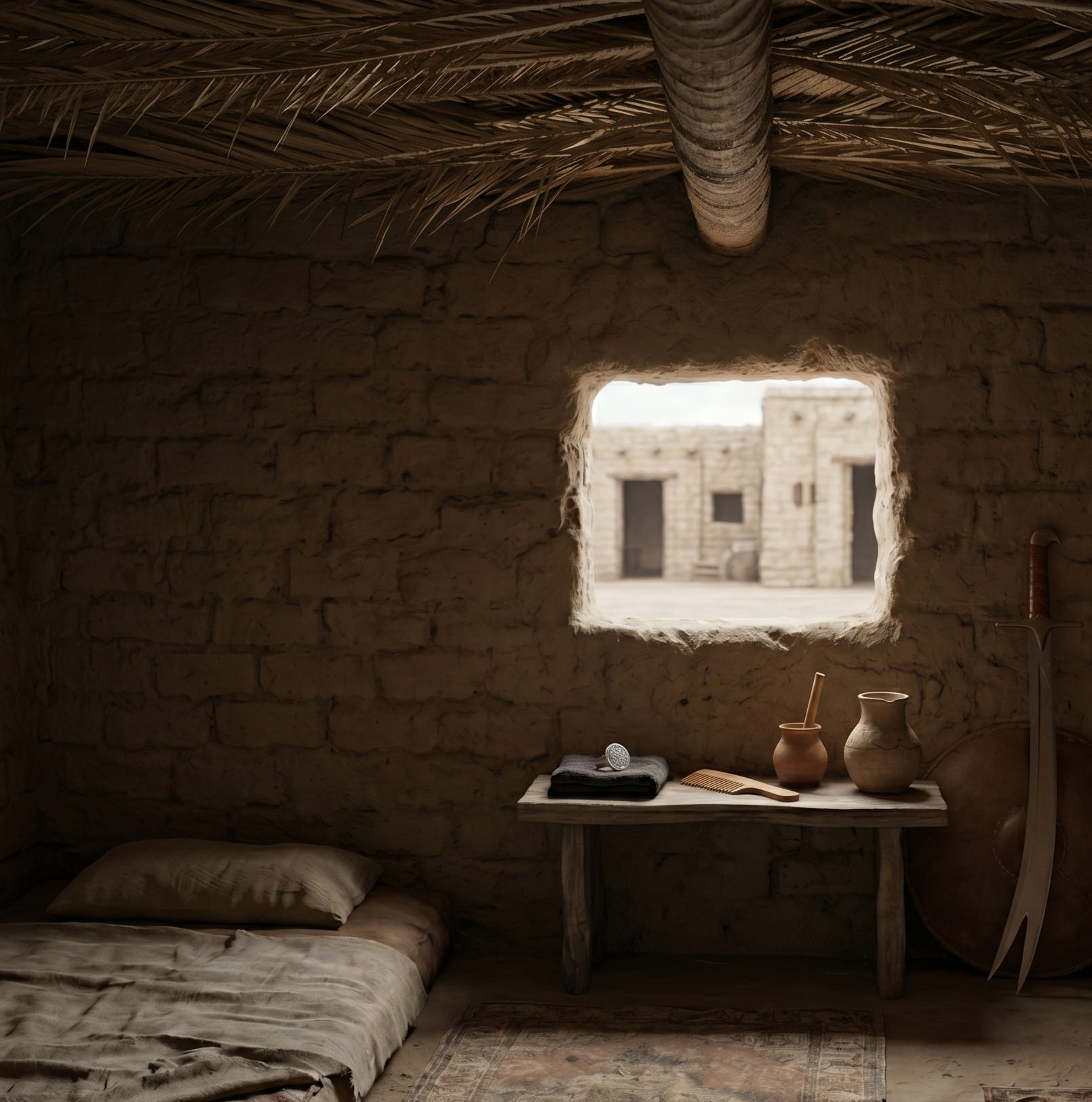
If you study the seerah of the Prophet Muhammad (peace be upon him), you meet a man of remarkably simple wants. He owned very little. This was true during the years of hardship and the long boycott his community endured, but it remained just as true later, when he had become the most respected and powerful figure in all of Arabia. His authority never rested on wealth. It rested on his character and his message.
His own household knew this scarcity intimately. Aisha (may Allah be pleased with her) reported: “A complete month would pass by during which we would not make a fire (for cooking), and our food used to be only dates and water unless we were given a present of some meat.” (Sahih al-Bukhari 6458)
Consider how he left this world. The man who reshaped an entire civilization in a single lifetime died with almost nothing to his name. Amr ibn al-Harith reported that when the Messenger of Allah (peace be upon him) died, he left behind no dinar or dirham, no slave, nor anything else, except his white mule, his weapon, and a piece of land that he had given away in charity. (Sahih al-Bukhari 2739)
No will to write, because there was so little to distribute. His focus was the message, and nearly everything else in the world struck him as a distraction from it.
The Stoic Equation
Centuries away and a world apart, the Stoics arrived at a strikingly similar conclusion. Epictetus put it plainly: “Wealth consists not in having great possessions, but in having few wants.”
For the Stoics, less was not deprivation but strategy. They understood attachment as exposure. Every thing you cling to, whether an object, a status, or an outcome, becomes another surface where stress, loss, and frustration can land. Shrink your attachments, and you shrink your vulnerability.
That exposure is no longer limited to the physical world. It now lives in our pockets.
Guarding the Mind in a Digital Age
In Digital Minimalism, Cal Newport describes a way of using technology in which you commit your online time to a small number of carefully chosen activities that genuinely serve what you value, and then calmly let go of everything else. You do not owe your attention to an endless feed. You do not need to fill your mind with manufactured outrage and curated negativity. Guard your attention the way you would guard anything precious, because it is.
Time Is the Real Wealth
The most valuable thing any of us owns is not in a bank or a portfolio. It is time, and it is finite. In Essentialism, Greg McKeown argues that every choice is a trade. When you say yes to a small, easy request, you are quietly saying no to something else, often your deepest priorities, your family, or your own recovery. The essentialist stops asking, “How can I fit it all in?” and starts asking, “Which problem do I actually want to take on?”
So, Declutter
You do not need the fancy car because your neighbor parked one in his driveway. You do not need the latest gadget that will feel ancient in six months. You do not need the investment that steals your sleep, or the app engineered to feed on your attention. What you actually need is far less than you have been led to believe.
So the next time you feel the pull of wanting something, pause and ask one honest question: will this genuinely add joy to my life, or will it quietly take a piece of my peace?