

That single choice will shape your physical health, your mental wellbeing, and your finances for decades. And yet most of us walk into it almost blindly.
When I say we rush, I am not talking about time. You can spend a year with someone and still not know them. You can also meet someone deeply compatible in a matter of weeks. The rush I mean is the rush to skip real work: knowing yourself, knowing what actually matters to you, and grounding the decision in revelation and time tested wisdom rather than in how someone looks or what they earn.
We tend to get the order exactly backwards
The Prophet (peace and blessings be upon him) named the four things people marry for and then told us which one to prioritize.
“A woman is married for four things: her wealth, her lineage, her beauty, and her religious commitment. So choose the one who is religiously committed, may your hands be rubbed with dust (i.e., may you prosper).” (Sahih al-Bukhari 5090; Sahih Muslim 1466)
Notice the structure. The Prophet (peace and blessings be upon him) listed the things people are naturally drawn to, then redirected us to the one that lasts. The principle applies equally to choosing a husband or a wife: lead with character and faith.
So why do so many of us prioritize in reverse? We pick someone for their looks or their bank balance, and only then go looking for the deeper qualities, hoping to find them. That is a cognitive trap. Once we have decided, confirmation bias takes over and we collect evidence for the choice we have already made.
Reverse the process. Start with what will still matter in twenty years, and let the rest be a bonus. Beauty, status, and wealth are the icing. Character and compatibility are the cake.
The Stoics arrived at the same conclusion from an entirely different direction. They classified wealth, beauty, and noble birth as “preferred indifferents.” Pleasant to have, but powerless to make a person good. Musonius Rufus, a Roman Stoic teacher, put it bluntly in his lecture On the Chief End of Marriage:
“For neither wealth nor beauty nor high birth is effective in promoting partnership of interest or sympathy... With respect to character or soul one should expect that it be habituated to self-control and justice, and in a word, naturally disposed to virtue. These qualities should be present in both man and wife. For without sympathy of mind and character between husband and wife, what marriage can be good, what partnership advantageous?”
Two traditions, separated by centuries and worldviews, pointing to the same truth.
What follows is a simple framework built on three criteria. Get these right, and you have the cake. Everything else is icing.
Criterion 1: Character and Integrity
As Muslims we are taught to be good in our character and our manners. The difficulty today is that outward signs can mislead. Someone who looks religious and uses the right vocabulary is not automatically a person of integrity.
So do not rely on the performance. Verify the substance. The way someone behaves when nothing is at stake for them, and when no one important is watching, tells you who they actually are.
Practical ways to check:
Look at how they conduct their business and money dealings. Do they keep their word, pay what they owe, and deal honestly?
Speak to people who know them in low stakes settings: colleagues at work, longtime friends, former teammates.
Watch how they treat people who can do nothing for them.
Above all, look for someone who will help you on your journey to Allah, who values Islamic knowledge and keeps a living connection to the Quran. A spouse like that does not just share your life. They raise it.
There is a piece of common wisdom that says you should marry down in financial status, since wealth comes and goes. When it comes to faith, do the opposite: marry up. Choose someone whose relationship with Allah is stronger than yours, someone whose example pulls you upward rather than letting you drift. The right spouse becomes a means by which Allah improves you.
Criterion 2: Humility (the No Pride Test)
Some pride is healthy. It is fine to take pride in your values or in caring for your health. But pride in wealth, status, or achievement, the kind that makes a person treat others as beneath them, is a serious warning sign.
“No one who has the weight of a mustard seed of pride in his heart will enter Paradise.” (Sahih Muslim 91)
Humility is the opposite of pride, and it is one of the most beautiful qualities a spouse can have.
“Charity does not decrease wealth, no one forgives but Allah increases him in honor, and no one humbles himself for the sake of Allah but Allah raises him in status.” (Sahih Muslim 2588)
A humble person admits mistakes readily, accepts advice graciously, treats everyone with respect regardless of status, gives credit to others, stays grateful to Allah and to people, and can apologize sincerely. Marriage will demand every one of those traits from both of you.
Watch instead for these red flags, grouped by what they reveal:
They cannot accept being wrong. They never admit mistakes, get defensive when corrected, blame others for their faults, and reject any criticism.
They look down on people. They speak condescendingly, mock or belittle others, constantly compare themselves favorably, and are disrespectful to parents, siblings, or service workers.
They need to be above everyone. They boast about achievements, name drop, demand to be the center of attention, and cannot celebrate someone else’s success.
They lack humility before Allah. They rarely seek forgiveness, show little gratitude, and carry a sense of entitlement.
How a person treats a waiter or a sibling when nothing is at stake will, in time, be how they treat you.
Criterion 3: Compatibility
It is tempting to reduce compatibility to chemistry and attraction. There is also the old belief that opposites attract. They do, but usually only for a while. Research on long-term relationships consistently finds that couples who share core values and life outlooks tend to last longer than couples who are simply opposites.
The compatibility that matters is alignment on the things you will actually live out together: Do you both want children? How do you each view family obligations? What are your spending habits? Money, in particular, is one of the most cited drivers of divorce, so financial compatibility is not a minor detail.
Think of a spouse as your co-founder for life. A startup has good seasons and brutal ones. Raising children is hard. Family obligations are hard. Adversity is not a possibility but a certainty, and the Stoics built their whole philosophy around that fact. So the real question is not whether your partner is fun in the good times. It is whether they will stay and fight beside you when fortune turns.
When you evaluate someone, ask:
Resilience and rationality: Do they meet setbacks with calm and clear thinking, or are they swept away by anger and anxiety?
Mutual care: Are they ready to care for you in sickness and in hardship, not just in comfort? Musonius taught that the entire point of marriage was mutual care in health and in sickness alike.
Islam honors this practical wisdom.
When Jabir (may Allah be pleased with him) married a previously married woman rather than a young one, the Prophet (peace and blessings be upon him) asked him why. Jabir explained that his father had been martyred at Uhud, leaving young sisters behind, and he wanted a mature woman who could help care for them. The Prophet (peace and blessings be upon him) replied, “You have done the right thing.” (Sahih al-Bukhari; see also Sunan an-Nasa’i 3226).
Individual circumstances matter, and choosing wisely for your real situation is praiseworthy, not unromantic.
How to actually test for compatibility
You cannot assess this from across a table over dinner. You need to see someone in motion. A few simple tests reveal a surprising amount:
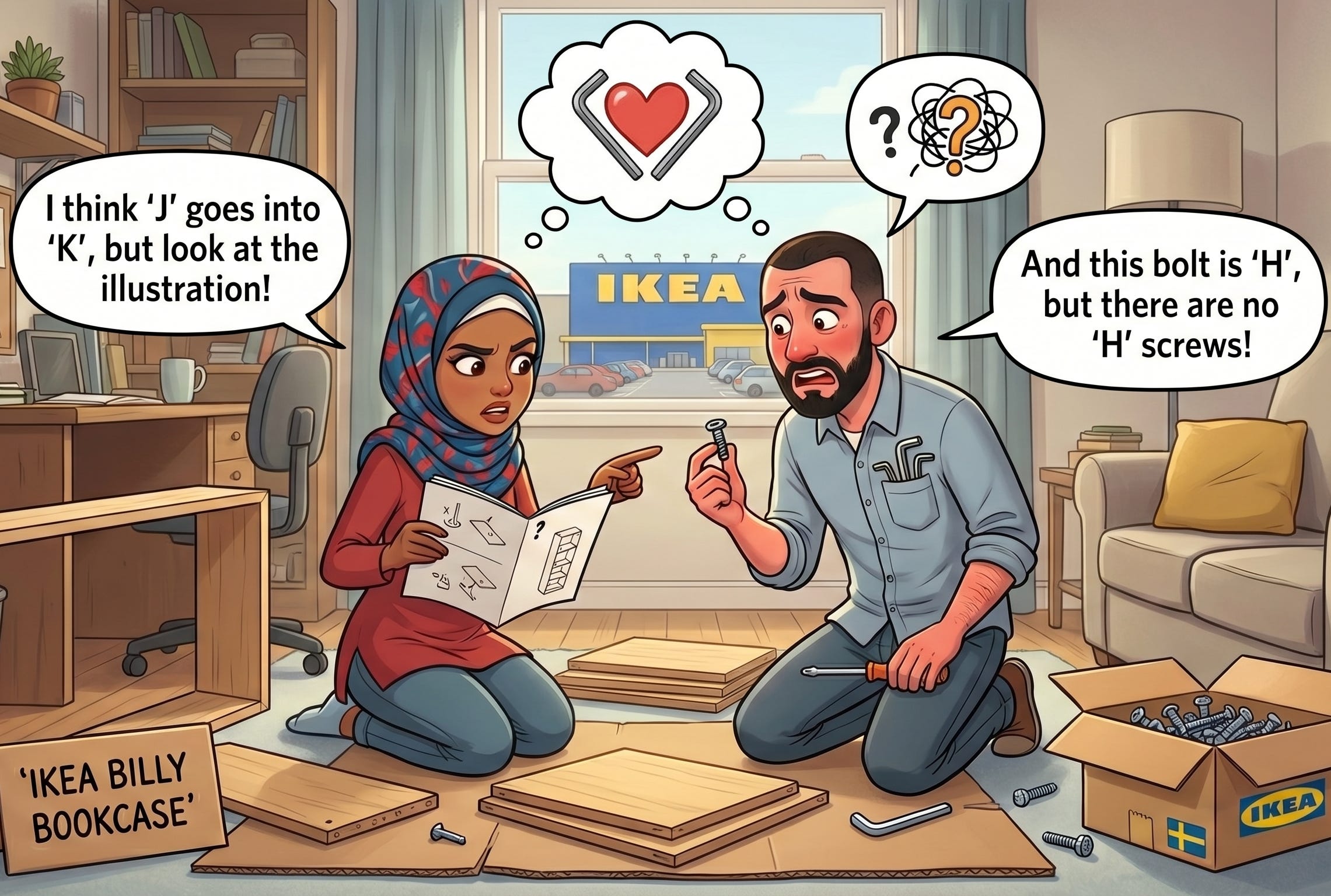
The IKEA test. Popularized by writer Sahil Bloom, the idea is simple: before you marry someone, go to IKEA together, buy a piece of furniture, bring it home, and build it. If you can get through the whole process without wanting to strangle each other, that is a good sign. Most people assume the test is about the furniture. It is not. It is about how the two of you handle confusion, frustration, unclear instructions, small disagreements, and a shared goal under mild stress. In other words, marriage in miniature.
Shop and spend together. Do the grocery run or any real errand together. You will learn more about their relationship with money in one outing than in ten conversations about it.
Serve together. Volunteer for a cause as a pair. You will see how they treat strangers, how they handle inconvenience, and whether their values show up in action or only in words.
After the Framework: Istikhara and the Courage to Say No
Once you have done the work, turn to Allah. The Prophet (peace and blessings be upon him) taught the Companions to pray Istikhara for all their affairs the way he taught them surahs of the Quran (Sahih al-Bukhari 1162). For a decision this large, seeking divine guidance is not optional. It is the final and most important step.
And then have the courage to act on what you find. It is easy to keep moving forward once you have started, because saying no is hard, and it only gets harder the longer you wait, far harder after marriage than before it. So if something feels genuinely off, find the courage to call it off. And if someone truly meets the things that matter to you, do not hesitate. Move forward.
Remember too that you will never find a perfect person, because there isn’t one. Often it is the imperfections in each other, met with patience and humility, that make a marriage something beautiful.
May Allah grant righteous spouses to all who are seeking marriage, and may He bless their intentions.
We often chase the most visible and flashy part the cherry 🍒 and ignore the foundation. Later we realize the rest couldn’t hold. So don’t marry the cherry on top of the cake.
Useful information